
Cabo San Lucas Marine Reserve: what the name means
The area commonly called Cabo San Lucas Marine Reserve or Marine Park includes the familiar bay-side rock and underwater settings around Land’s End. Its formal protected-area category is Área de Protección de Flora y Fauna Cabo San Lucas, administered by CONANP. It is separate from Cabo Pulmo on the East Cape.
Use the Cabo San Lucas Bay guide for the overall geography and direct official information source. This article focuses on visiting the protected marine setting and choosing an appropriate activity.
Getting onto the water
Many boat, snorkeling and scuba outings leave from the Cabo San Lucas marina. Some beach-based services have different meeting places, so confirm the dock or pickup point rather than treating every trip as the same departure. Short distances across the bay do not remove boarding, briefing or activity requirements.

Protected status does not mean every activity is unrestricted
Ask an authorized provider about the current permitted sites, applicable charges and proof of payment, and any temporary restrictions. Follow park staff and crew instructions. A general travel guide is not a substitute for the current zoning or an operator’s authorization.
For decisions on entry and activities, use the official park information linked through the bay overview and the instructions at your actual departure.
Snorkeling and scuba are different activities
The bay has shallow areas and steep underwater slopes. A location described as a good dive site is not automatically an appropriate snorkeling area, and a wall extending to depth is not a suggested route to its base. Explain your training, recent experience and comfort in the water before agreeing on a trip.
The guide should select the actual site and profile around conditions and the group. Do not substitute a list of rock names for a briefing about depth, entry, currents, boat traffic and the return to the boat.
Pelican Rock

Pelican Rock is a familiar snorkeling and dive setting, with fish and rocky habitat. Different parts and depths suit different activities. Do not describe the entire area as suitable for every ability or enter from a beach without checking access and the local instructions.
Lovers Beach and nearby shores

A beach landing is a separate part of an itinerary, dependent on conditions and transport arrangements. The bay-facing shore and the Pacific-facing Divorce Beach must not be treated as one swimming environment. Do not swim at Divorce Beach, and do not swim across boat routes between sites.
Neptune’s Finger

The exposed pinnacle is a sightseeing landmark with underwater rock features and steep slopes nearby. Read the Neptune’s Finger site guide for the distinction between seeing the rock from a boat and planning a guided dive.
Sand Falls
The bay’s sand falls are underwater sediment cascades associated with slopes and canyon edges. They are not a waterfall that can be viewed by swimming from one landmark to another. The Sand Falls guide explains the phenomenon and the need for a dive plan suited to the group.
The Arch and the sea-lion area
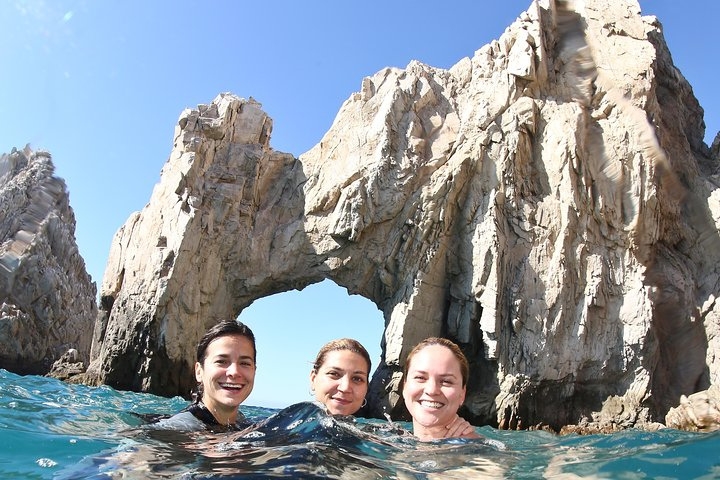
The Arch is best understood as a viewing landmark, not an instruction to swim or paddle under the rock. An outing in the wider headland area needs an appropriate site chosen by the guide. Do not enter caves or approach a resting colony to improve a photograph.

Watch sea lions and other wildlife at a distance. Do not feed, pursue, touch or deliberately enter the water beside them. A safety stop is part of a dive plan, not a reason to lie on the seabed or seek close contact with animals.
Conservation during your visit
- Keep equipment and fins clear of living habitat, and maintain control in the water.
- Do not stand on coral or collect shells, rocks or animals from protected habitat.
- Stay within the guide’s chosen route and follow any closure or changed itinerary.
- Take litter away and keep food or waste out of the sea.
- Ask about the actual rule or restriction rather than assuming that “marine reserve” means the same permitted activities everywhere.
Fish, sea birds and seasonal wildlife are part of the appeal, but an individual species or close encounter cannot be promised. Enjoy the site the conditions allow rather than treating a promotional wildlife list as an itinerary.